Pages

Wednesday, July 22, 2015

Bloodjak and a Return to Conventional Game Design


Surprise! I made a game last weekend! It's called Bloodjak.

It's a fun little side-scrolling arcade shooter set in cyberspace. I made it in 72 hours for the Indies vs Gamers jam at Game Jolt (voting is still underway this week, so be sure to play some games and vote for your favs).

I outsourced the music to a fellow named Geoff Backstrom, and I'm glad I made the decision. The game sounds kick ass.


It might possibly be the best complete game I've ever made. It's also the most conventional game I've ever made. This is not the sort of game that idealistic teenage me wanted to make. In fact, it's a very radical departure from the sort of games I was working on when I started this blog, and is personally significant for that reason.

This isn't the first time I've written about how I've felt weird about the games I make. But it's a different sort of weirdness than I felt when I made The Void Hero Blues, thankfully.

Look, if you just want to play and enjoy the damn thing, stop reading and do that. You should play it. It's fun. It's hard. It looks cool. It sounds great. I'm really proud of this one, and I think it'll do well in the competition. But if you want to read about what the game means to me, well, get comfortable. This might be one of the more self-indulgent things I've written. I don't care.

Things have come full circle in the strangest way. Let me explain at the beginning.


Making Games as a Child: In Pursuit of Fun

The earliest games I made as a pre-teen were mostly shooters and fledgling attempts at RPGs. Run-of-the-mill stuff - imitations of the mainstream games I was playing at the time. It was 2005. The contemporary indie game scene was barely forming. The artgame, notgame, Twine game, and altgame scenes were, as far as I know, totally nonexistent. Communities for hobbyist game development around certain tools, like Game Maker, existed, but those communities were isolated.

By 2006 or so, I got pretty good at making shooters, for a scrawny 13 year old boy. Me and a bunch of other 12-14 year old boys were making first person shooter games with this software called Silent Walk (the original, low tech version that we used is hard to find nowadays). In retrospect, I was probably one of the more prominent of the young game designers in that community. I was the first person to have created a game in Silent Walk with original 3D models (they looked like shit), and also had a reputation for being one of the few people who made a game with stairs in it (it was a big deal). Silent Walk, while very accessible, wasn't very powerful, didn't require code, and was used by a bunch of preteens. The quality bar was pretty low, but I surpassed the bar, damn it.

I owe a lot to that community. Just thinking about it reminds me of how magical the internet felt back then.

Point is, I gained a ton of experience making action games during my first 3 years of game dev as a kid. I think that experience greatly influences my game design today. They were formative years.

My design tendencies changed around 2009. I was 16, and was finally learning how to think for the first time (still trying to get it down, honestly). Tale of Tales released The Path that year, spawning the artgame and notgame movements (near as I can tell) and changing what many people believed was possible with interactive media. I was one of those people. "Wait a minute, you're telling me that I can create interactive art without goals, challenges, violence, competition, risk, or any of the things that have made games what they are until this point? And it can actually be good? Sign me up!"

Making Games as a Teenager: In Pursuit of Emotion

Notgame design philosophy fundamentally changed my mission as a game designer. My goal was no longer to make games that were fun, but games that were profoundly emotional. I am still trying to meet this goal - it's six years later, and I do not think I have yet succeeded.

How to Fly was the first notgame I created. You play as a bird who flies around eating mosquitoes in mid-flight. The more you eat, the larger you get. However, by the end of the game, you shrink back to normal size, then are transformed into a mosquito for some reason, before getting hit by a truck and dying. Your score is reduced to 0.  The game is full of symbolism, the original meaning of most of which I have since forgotten. In retrospect, it's a pretty game, and one that I appreciate, but it's not the emotionally profound masterpiece that my teenage self set out to create.

How to Fly
I remember presenting the game to the Game Maker Games community and it was immediately shot down. Everyone there hated it for it's lack of traditional game elements. My ego was crippled. 

Later that year I created A Day by the River, a game made for a high school English class project about the importance of civility. Notgame design philosophy also guided this project. However, this game had also failed to meet my objective of emotional maturity. In fact, the game I made was about as emotionally immature as I was. The game was supposed to be serious and dark - instead, the class laughed most of the way through it. I didn't realize it at the time, but the game is actually quite ridiculous.

For the next three years, I would struggle to complete any game projects. Waker was one of the last project that I started with artgame or notgame design philosophy in mind. It was one of the last times I attempted to create something with deep emotional significance. The game has been in development hell for 3 years now and counting. Making people feel things outside of tension and fear through video games is hard.

Making Games in College: In Pursuit of Thought

Two things happened during my college career that resulted in another large shift in my design tendencies. The first was that I got a little better at thinking. The second was that I became exposed to games and writings of  "punk" game developers: developers associated with the queer, Twine, and most recently, alt games scenes. These developers were not only conscious of the social and political themes in games, but in the social politics surrounding the creation and play of games.

Whereas artgames and notgames, traditionally, held themselves to high aesthetic standards, punk games usually were less concerned with aesthetics and more concerned with ideas.

This isn't to say that art games aren't about ideas, or punk games aren't about emotion (indeed, all of my attempts at artgames have been very message-driven). But I think that my exposure to punk games prompted me to focus primarily on the ideas of my games without trying to purposefully evoke emotion through aesthetics.

My mission as a game designer had expanded: not only did I want to make games that made people feel, I wanted my games to make people think. I didn't necessarily want may games to be fun - but if fun happened along the way, I wouldn't lose sleep over it. 

Empty Chambers, Digital Toilet World, The Void Hero Blues, Mandibles: Change is Coming, and Monsterpunk are all games in which I attempted to communicate ideas through narrative or mechanics. Most of them purposefully disregard typical aesthetic standards in games, and, as a small act of rebellion, none of them feature white male protagonists. Chambers and Void Hero both criticize traditional conventions in first person shooters.  Mandibles has overt political themes, and Monsterpunk subverts gender expectations and has themes of environmentalism and pacifism. Even Digital Toilet World has underlying themes about religious zealotry and the futility and dangers of human progress (it's not just a poop joke)!

Monsterpunk
Over time, you can observe my game design become more conventional with each  of my creations. Among Chambers, Toilet World, Void Hero, and Monsterpunk, Chambers is the most mechanically subversive, giving the player a gun and then rewarding them for not using it. Toilet World and the Void Hero, while emphasizing their anti-game quirks, are more conventional, featuring and encouraging shooter-based combat throughout. This was especially problematic in Void Hero, a game which attempted be both a criticism of first person shooters while also trying to provide Quake-esque gameplay. Monsterpunk is the most game-like of any of these, featuring layers of complicated rules and mechanics and traditional win conditions.

Bloodjak is the conclusion of this trend towards convention. The Indies vs Gamers jam had two requirements for its entries - the game had to be arcade themed, and the game had to feature online high score table support. While it is possible to create experimental works that meet these criteria, I had trouble coming up with a good artgame or punk game idea that did within such a short time period. So I made a shooter.

It is not a game designed to make you think. It is not a game designed to make you feel anything beyond tension, fear, and excitement. It is a game that is meant to be fun.

I'm back where I started. 

Making Games Now?

Bloodjak's been out for a few days now, and it's already becoming one of the most well-received games I've ever made. People have been telling me that they love it. One person's already enthusiastically competing for the first spot on the high score table; a kid's already recorded four minutes of gameplay, threw it on Youtube, and gave the game an astounding recommendation. The game's received more ratings on Gamejolt than anything else I have on there, and not one of them has been negative, which is unusual for me.

 
Don't get me wrong: I'm really glad people are enjoying the game. I enjoy the game. I'm really glad to have made the game! At the risk of sounding arrogant, it's a good freaking game. However, Bloodjak is not the sort of game I expected to be making at this point. My mission as a game designer for the past six years has been to tell meaningful stories, stories about politics and human experience, stories told through games that are accessible to both gamer and non-gamer audiences. I've had mixed success trying to do that, and perhaps am now having great success not doing that.

Hopefully, the creation of Bloodjak will give me the room I need to finally tell those stories I've been wanting to tell. Most of the games I've been over the past two years have straddled the line between convention and experimentation - I wanted to change people's perceptions of what video games could be, but felt a need to prove to the world that I already understood what video games were. I felt as though I needed to demonstrate not just a willingness to break the rules, but a complete understanding of them.

Bloodjak, I hope, is proof that I can design a conventional game, and do it well. Now, maybe now, I can give myself permission to start making stuff that's more beautiful, nonviolent, personal, political, and experimental than the games I've made up to this point. Or, at least I can try to.

In the meantime, blow up shit and have a good time doing it.


Wednesday, May 6, 2015

High Transit and a Thesis

I keep making things. Today, I am sharing two of those things with you.

1) High Transit

High Transit is a team student project for which I was the primary programmer and level designer. In the game, you get to jump on fast moving trains in the sky. That is pretty cool. What's not cool is that it's loaded with bugs and rendering issues.

I feel incredibly conflicted about the game - more so than I usually feel about my projects. It is not the most polished, personally expressive, subversive, or experimental thing I've worked on. However, it does feature some of my best  mechanics and level design, and is a blast to play.

Check it out on Game Jolt!

2) Cuties Killing Video Games: Gender Politics and Performance in Indie Game Developer Subculture

I spent the past year writing a 200 page thesis about how online communities and noncapitalist modes of game production make feminist politics in gaming subculture possible! I figured it might be of interest to some of you in such communities who use such modes of production to perform such politics.

You can download it from here!

With both of these massive projects out of the way, expect more Toilets Meat and Drugs development, and the actual return of Radical Playing.

Tuesday, April 21, 2015

Mandibles: Change is Coming

I just finished writing a 200 page thesis called Cuties Killing Video Games: Gender Politics and Performance in Indie Game Developer Subculture. To celebrate, my thesis advisor and I collaborated to create our first Twine game!


It's called Mandibles: Change is Coming. Look around a room. Don't get your head bitten off by an ant. Start a revolution.

We created it an hour. It is amazing regardless.

With the completion of my thesis, work on Toilets, Meat, and Drugs is picking up again. I might have something else cool to show before then.

Sunday, March 29, 2015

Toilets, Meat, and Drugs Development Update

Sorry for the continued silence on this corner of the net. I am unable to work on my personal game projects at an ideal rate - my thesis and student development work continues to take priority - but some progress has been made! Character dialogue in Toilets, Meat, and Drugs is nearly complete. In fact, now whenever you flirt with characters in game, they'll say something cute! Or they'll reject your (probably) inappropriate advances.


Oh, and now when you take pills in the game, you'll hallucinate! I really want to drive home the negative aspects of drug/medication dependence in this game, and it was difficult to do that without adding an explicitly negative consequence to popping pills in game. Not only will hallucinations visually impair the player, but the longer you've been taking drugs in game, the longer the hallucinations last. I think the new feature makes the in-game decision to take drugs a lot more interesting, and adds a ton to the game's flavor.

I myself have had horrendous experience with ADD medication, and wanted to capture how awful that experience can be through a game. Being able to better explore themes of drug dependence, both recreational and otherwise, adds a greater degree of personal relevance to the game that makes it more engaging to me, and hopefully to others too.

I've only just now noticed how suggestive this screenshot is. Eh, the hallucination is randomly generated, what can you do?

I was worried for a long time about whether I was spending my time wisely continuing to work on Toilets Meat and Drugs - I've spent nearly nine months now on something that should have been a side project, and the jam version of the game was one of the most poorly received games I've made. I've spent a lot of time on a project that had a very real potential to be unenjoyable to a general audience, but now that I'm reaching the end of development, I think that the risk is going to pay off. The game has so much soul. If I were a video game, I would be Toilets, Meat, and Drugs.

I've pushed the expected release date to summertime. Sorry for making everyone's Christmas miserable by not releasing the game by then like I said I would. This year's Christmas will be better.

Tuesday, December 30, 2014

Postmortem: The Void Hero Blues, Constraint, and Violence


The Void Hero Blues was a strange game to make. While I've been making games for nearly 10 years now, it was not only my first university student project, but also my first game to feature post-1998 quality 3D graphics. The context within which I made the game determined not only the development process, but shaped the concept itself. If I didn't have to make a game under the conditions I did, I would not have had any desire to make The Void Hero Blues. Unlike the rest of my work, this did not start out as a passion project.

I feel a very strong ambivalence about the game. On one had, it is probably one of the most technically impressive, visually interesting, and mechanically solid games I've ever made. On the other, the game's treatment of violence simply makes me uncomfortable. Let me explain.

Constraint

If you aren't familiar with the game, The Void Hero Blues is a short first person shooter in a cyberpunk setting. The player character, Void Girl, is stranded in a  pseudo-virtual environment, and must fight enemy security forces and survive for nine minutes. The catch is that every time she kills an enemy, a message will appear where they were slain that shares personal information about them. As her enemies are de-objectified, Void Girl's mood deteriorates. By the end of the game, she puts down her gun and stops fighting altogether.


The game was made over a semester and a half as an undergraduate student project at Ohio University. Most of the projects created in my class were made by teams of five or more people. Most of the members of these teams had never worked on a game before. Because I had a bit more experience than my classmates, I was pretty quickly bored with the team project I was initially assigned to, and figured that I could probably accomplish more on my own. Much to my surprise, my professor was kind enough to let me work on a solo project.

With most of my recent game projects, I strive to make something that is personal, experimental, subversive, or soulful. However, with this student project, I didn't have the free reign to do whatever I wanted as I usually did. I had to make a game using Unity 3D (which I had never done before), and I had to make it within a semester and a half. For the first time in a long time, I had to make a game using tools I was mostly unfamiliar with.

Most importantly, however, I felt a need to prove myself to my professor, and to the class. I felt that I needed to justify the privilege to work alone that was given to me. At the time, I felt that I couldn't get away with whatever nonviolent interactive art I wanted to do. Instead, I felt that I had to demonstrate that I could make a traditional game, with traditional mechanics, and do it well. I felt as though something that wasn't a "real" game wasn't going to cut it.

In short:

1) Because I had never made a 3D game in Unity before, I had to design a game that was easy to make.

2) Because I thought I had to prove that I was capable of design good, traditional game mechanics, I decided to focus on making a "fun" action or strategy game rather than an interactive story or "art game".

3) Because I have more experience making shooters than any games of any other genre, I could most realistically make a complete shooter game in a semester and a half. Making a shooter would also satisfy the requirement that the game is "fun" in a traditional sense.

4) HOWEVER, I also wanted the game to be subversive in some way. I wanted to be critical of the way in which violence was portrayed in games.

This is how I came up with the concept for the Void Hero Blues. It was one of the few concepts I could conceive that met the criteria for ease of development, fun, and subversion. However, it is the compromise between  fun and subversion that causes my discomfort about the project.

Violence

I think about violence in games a lot. I grew up playing shooter games and RPGs, and such games have probably been the largest influences on me as a designer. Even when I make a game about monsters that poop on the ground, I still rely on violence as the fallback mechanic. As a game designer, it's a habit that's been strongly ingrained in me, and I resent it.

Having violence as the primary way through which a player interacts with a game world severely limits the type of story you can tell through a game. For most people, the infliction of violence by them isn't a prominent aspect of the human experience. Halo, Quake, and Jedi Outcast are lots of fun, but at the end of the day, fun is all they are. Lately, I've been finding that narrative games in which violence is tangential to or absent from the experience, such as The Walking Dead, Sword and Sworcery EP, and Kentucky Route Zero, are far more compelling and meaningful. If I find a game primarily concerned with combat to be at all compelling, nowadays it is in spite of the violence, and not because of it.

In sprite of my criticism of game violence, every game I've worked on over the past two years besides Waker has been, in some form or another, a shooter. In three of those four cases - Empty Chambers, Toilets Meat & Drugs, and The Void Hero Blues - I attempt to provide critical commentary on violence in games through my game's mechanics. In these attempts, the violence in Empty Chambers and The Void Hero Blues both have left me uncomfortable, and the only reason it hasn't in Toilets Meat & Drugs is that the violence that does occur is between non-human cartoon characters.

In the case of The Void Hero Blues, I think that the cause of discomfort is the dissonance between the game play and the narrative content. The game's protagonist is a reluctant fighter who grows self disgusted with each life she effortlessly takes, but actual player has a different experience from her. Dodging lasers, finding health packs, and killing enemies are all fun things for the player to do. The visual and audio feedback the player receives upon sinking their blade into an enemy's flesh is satisfying. If you remove all of the narrative and subversive elements from the game, you're (arguably) left with a satisfying minimalist shooter. It is the game's biggest problem. I tried to make something that was both compelling and fun, and in this case, these two goals were at odds with each other.


Because of the game's dissonance between its game play and its narrative, I think that the game's message - that every stranger we meet is a human and not an object - was lost on a lot of the players. Some people I've met online were impressed by the game's subversive elements, but most of the people I've watched play the game only talked about the mechanics, graphics, and features of the game, not its meaning. Many players, as they played the game, actively expressed a lack of sympathy for the characters they killed, sometimes mocking them as they shot them, or remarking that they deserved it. In the case of these players, the game had failed to accomplish what I had hoped it would accomplish - feelings of sympathy and remorse.

In spite of my ambivalence about the game, I am proud of it, and if you haven't played it yet, I hope you do, but I still feel really odd about the finished project. Once I complete work on Toilets, Meat, and Drugs, I'm going to take a break from violent games for a long time. After much experimentation, I think I've realized that violent mechanics aren't going to help me achieve what I want to achieve as a game developer. I want to tell stories that are relevant to people's lives, and I know now that attempting that through action games will likely be a waste of time.

If you have played the game, how did you respond to it? Did you find it enjoyable, meaningful, or compelling in any way, and if so, why? In regards to my more general discussion of games and violence, am I actually full of shit? Please let me know.

Friday, December 19, 2014

Radical Playthings: Bottle Rockets, Frail Shells, I'm Scared of Girls, and More

I've kept a list of neat-o freeware games over the past eight months that I've been meaning to share with everybody, but between game development, thesis writing, and reflecting upon current events in game community*, I haven't had too much time to write about any of them. Now that the year's winding down and everybody's writing their game-of-the-year lists, I'm feeling a little pressure to write about all of the cool stuff I played this year before I get to the GOTY material.

I do intend to dedicate more of this blog to freeware indie game curation in the future. The hole left by freeindiegam.es still hasn't quite been filled (although Warp Door comes pretty close), and I'd like to do my part to help share the small, otherwise unheard-of games that are well worth your time. So, I am pleased to announce that I am formally rebooting the (bi-?)monthly Radical Plaything(s) Blog Post Series!

I intend to focus on freeware, indie, alternative, punk, political, and experimental games in the new Radical Playthings posts. I might write about the occasional twitch shooter or small commercial release, but such recommendations will be made sparingly.

Because I have so many games I want to cover this month, my commentary will be fairly sparse this time around. Without further ado, here are this month's radical playthings!

Bottle Rockets by James Earl Cox III

"Bot­tle Rock­ets is a music videogame about a mother and her daugh­ter...
It is a game to play when you feel sad."

Do you know the terror of attempting to escape a burning space station as it plummets into the earth, knowing that your effort is in vain and you will never see your family again?

Bottle Rockets give you some idea of what that feels like. For such a small game, it's heavy.


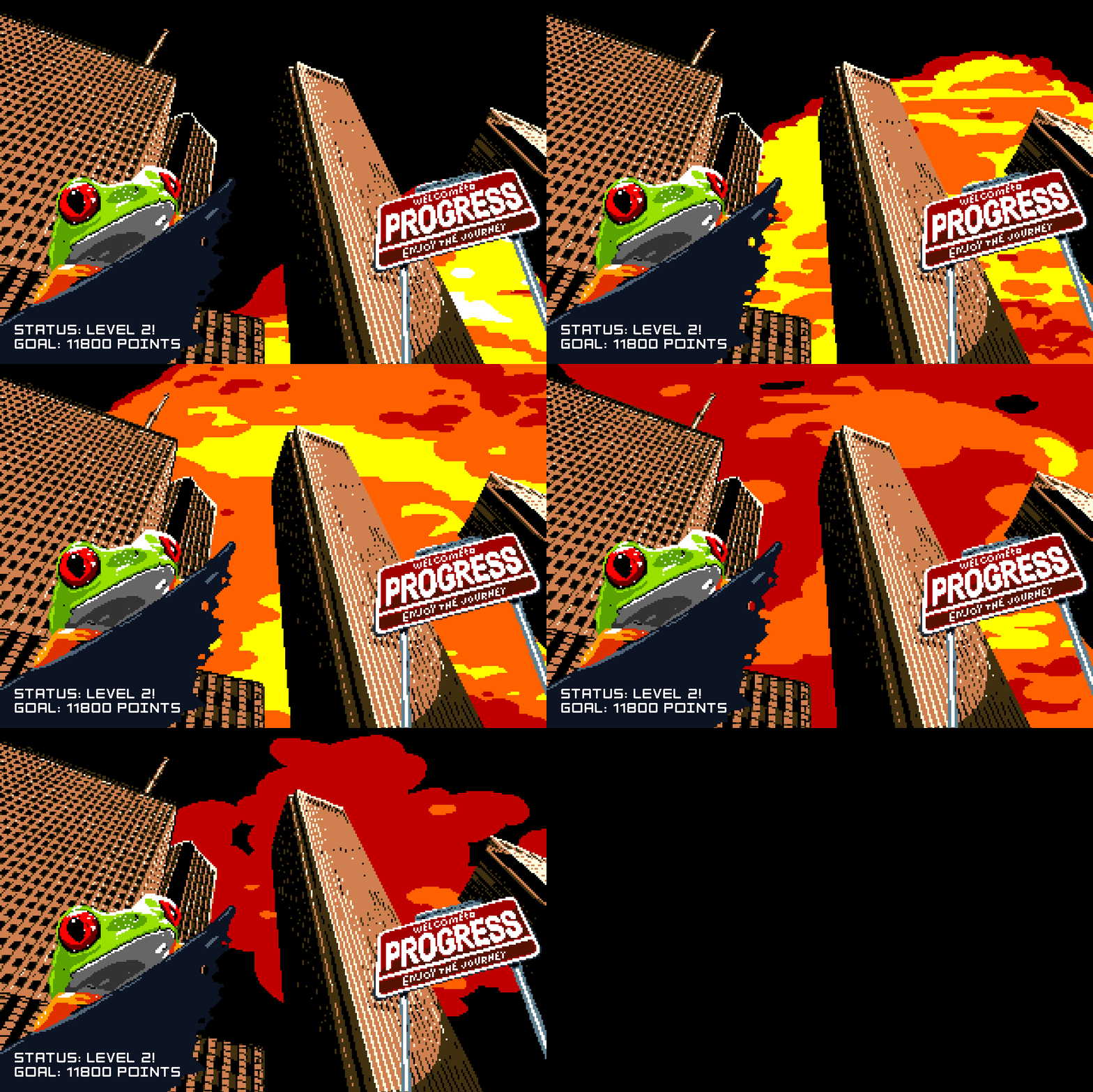
Froggy by Tetrageddon Games


"FROGGY is the legendary froggame that forever changed frogtelling in the frogindustry with its groundbreaking narrative. Many critics have heralded it as the Citizen Kane of frogs. FROGGY’s most notable achievement was the accurate representation of frogs, for which it won many frogminations in froggytainment, and PC Frogger’s Frog of the Year award. In this no holes barred froggame you frog as FROGGY, a seasoned frog veteran with a strong inner-voice but no moral conviction, surviving one day at a time on Armageddon Highway. For the first time ever play the remastered version in full 2D froggraphics!"

 I haven't enjoyed a game purely for its tone in so long. Froggy's gameplay is fairly unremarkable (eat bugs, don't get hit by cars), but the bizarre setting, stylized, quality animation, and funny writing make for one hell of an experience.

Witness death and carnage on Armageddon Highway as Froggy. Do it. 


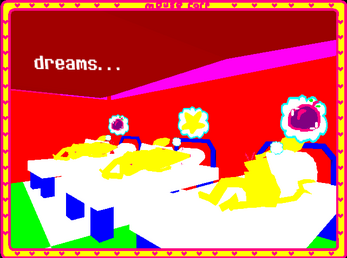
Mouse Corp by thecatamites


"Explore a field of caves and ruins under the benign aspect of the Mouse Corp. A mysterious 3d adventure awaits your survey. It's Mouse Corp. - what are friends for?"

SPOILERS FOLLOW, but it's a short game, so whogivesafuck.
Mouse Corp is cute and sad. You lead a group of mice on an expedition, fighting monsters and collecting berries, but over time, your comrades defect. By the game's end, you are all alone, with nothing to do**. There's no game over screen. Instead, you're simply left to experience an empty world. I'm honestly not sure how I feel about it.

Download Mouse Corp for Windows, Mac, and Linux (pay what you want).

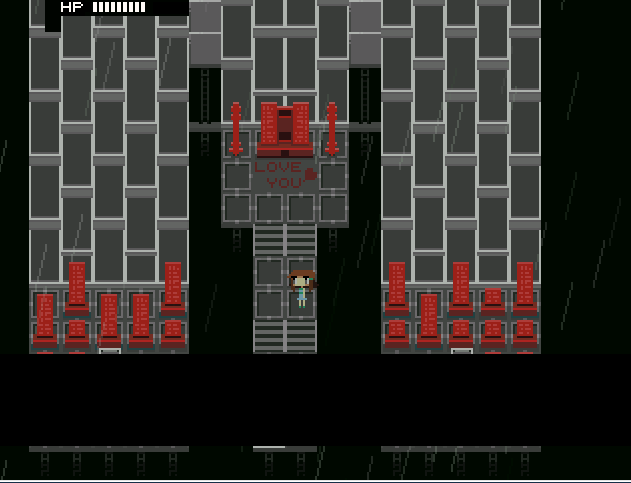
I'm Scared of Girls by Moga

"Explore the depths of death, gender, and unhappy places in this surreal action game!" 

An adventure RPG in which you play as a gender nonconforming boy in the afterlife, who must cut all ties with his past life before being reborn . Solid little story, haunting music, great aesthetics and atmosphere. The game is quite compelling.


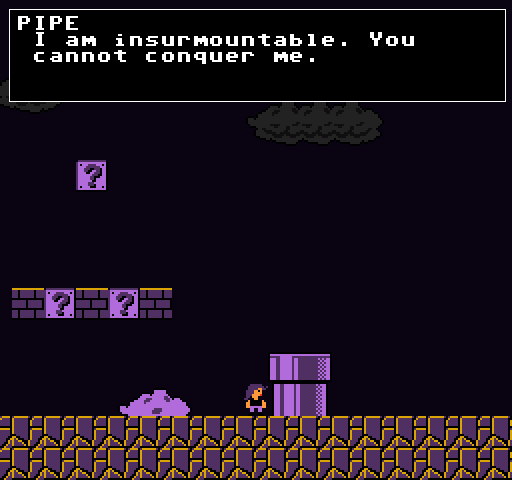
Average Maria Individual by Alice Maz

"You are MARIA. Why are you here. What's going on. Wait is this Super Mario Bros 1-1.

Find yr girlfriend! Defeat yr enemies! Jump no higher than half a tile!

The only mechanics are walking and light conversation and the only puzzle is don't act like a gamer. (There are some cool gameovers if you do tho)

Will you complete yr quest?? Yea prolly"

Nice little subversive parody of Super Mario Bros with themes of nonviolence and queerness. It pissed off some Gamergater-y types who made some awful response games (I played one of them and needless to say it was not cut out for this list). It's pretty weird that a harmless walking simulator with a gay protagonist that got such a strong counter-response***. Crazy times we live in.

Anyway, the game itself is an interesting little thing.


VA-11 HALL-A by Sukeban Games

"In this world, corporations reign supreme, all human life is infected with nanomachines designed to oppress them, and terrifying White Knights ensure that everyone obeys the laws.

But, this is not about those people.

You are a bartender at VA-11 HALL-A, affectionately nicknamed 'Valhalla.' Although it is just a small bar downtown, it attracts the most fascinating people this side of dystopia. Keep your clients lubricated and you will be made privy to the most interesting stories."

VA-11 HALL-A is a visual novel in which you, a cyberpunk bartender, influence the story based on how you mix your client's drinks. Currently, only the prologue is complete, but the setting is intriguing, and the game's story and mechanics show much promise. 


Frail Shells by Taylor Bai-Woo

"Shells fall from the sky

Like rain on a day that's just a little too cold

Shells shatter like ice

Against a pan that's just a little hard to hold"

Frail Shells is a first-person shooter game that's more concerned with what happens after war than with war itself. It has a wonderful visual style and uses interactive mechanics to tell a story in a really clever way. It's damn near heartbreaking.

Download Frail Shells for Windows, Mac, or Linux (pay what you want).

And that's it for this month's Radical Plaything(s). A bunch of stuff for you to play that will make you feel sad or awful. Cheers.

*yes, that thing
**Unless I suck at Mouse Corp and am totally missing something.
***Hell, I even got a slight reaction for my latest game having a female protagonist, which surprised me. More about that soon.

Sunday, December 7, 2014

AIN'T NO BLUES LIKE THE VOID HERO BLUES

I am very pleased to announce that The Void Hero Blues is now available for download!

You can check out the game and download it from itch.io. You can also do the same from Game Jolt, but, let's be honest, the itch.io page is better looking.

I have some things I'd like to say about the game, especially regarding themes of gender and violence, but I'm fairly exhausted from cranking this beast out, and would like to get more feedback first.

Thank you so much for playing! I'm very proud of how this one turned out.


Now that The Void Hero Blues is good and done with, you can expect a lot more writing from me over the next few months, as well as the imminent release of Toilets, Meat, and Drugs: A Pink Monster Story. TM&D has been painfully close to completion for the past month and a half - until now, I simple haven't had the time to give it the little push over the finish line. 

It's been five months since I've worked on Waker. I needed a break, but am trembling with anticipation at the thought of working on it again. I think developing The Void Hero Blues has been a huge transitional phase for me as a game maker, for reasons I'll get to in the next post. I feel energized in a way I haven't felt in a long time. I think I can make Waker really, really special, not only because I have the technical skill, but because I feel driven to do so in a way I haven't felt in a long time.